Every owner I talk to has a version of the same story. A lead came in, someone meant to call, and three weeks later it turned up in the CRM with no activity, or worse, as a customer of a competitor.
The usual diagnosis is people: the sales team isn't disciplined, the new hire doesn't follow up, somebody dropped the ball. So the usual fix is pressure, a new CRM, or more automated email.
In my experience that diagnosis is usually wrong, and the fixes make it worse. Leads don't fall through the cracks because people don't care. They fall through because nothing in the business decides what state each lead is in and what should happen next. That job is left to whoever happens to remember.
What I found when I actually counted
I built and run a lead and relationship system, RachelOS, for a South Florida real-estate business. The business had everything it was told to buy: a CRM, a website with lead capture, email, texting, and a steady flow of inquiries. The owner was capable and busy. She was also, in practice, the only place where it was known who needed what.
When the system's own audit counted everything (as of July 2026), three findings changed what I built next:
- Of 152 leads, 35 had never been contacted at all. Not ignored on purpose. They simply had no owner, no status, and no next step, so nothing ever surfaced them.
- Of the 117 that were contacted, 9 replied. The business had been treating "we reached out" as the same thing as "we're in a conversation." It isn't.
- Email-first outreach had a 2.2% reply rate. Calls and texts did noticeably better on small samples. Email had become the default first touch because it was the easiest thing to automate, not because it worked.
Those numbers come from one business, and the samples are small. They are not a benchmark for yours. What should transfer is the order of operations: count before you automate. The obvious response to weak follow-up would have been to build more email automation. The evidence said the opposite, so the next build made calling and texting easier instead.
The real reason: a system of record, not a system of action
Your CRM is a system of record. It is good at storing what happened: the form fill, the email, the note someone typed after a call.
What it usually doesn't do is decide:
- What is true about this lead right now? New, contacted, in conversation, waiting on them, waiting on us, gone quiet.
- Who owns it? One named person, not "the team."
- What should happen next, and by when?
- Which of today's leads matters most?
When nothing decides those things, a person does, from memory, every day. That works at twenty leads a month. It quietly fails at a hundred, and it fails completely the week that person is out.
The five places leads leak
1. First response
The first reply sets everything that follows. It leaks two ways: it's slow, or it goes through the channel that's easiest for you rather than the one that works for them.
Ask your CRM: For leads in the last 90 days, what was the time to first real contact, and through which channel? How many never got one?
2. No owner
A lead assigned to "sales" or to a shared inbox is owned by nobody. Everyone assumes someone else has it. This is where most of the never-touched leads in RachelOS came from.
Ask your CRM: Can you filter to open leads with no named owner? How many are there?
3. Unclear status
When I untangled RachelOS, there were five different fields trying to say where a lead was: status, stage, lead stage, lifecycle stage, and journey state. They disagreed with each other. So every decision started with the question "which field is right?", and usually the answer was "ask the owner."
Ask your CRM: How many fields, tags, pipelines, or spreadsheets describe where a lead is? If two of them disagree, which one wins?
4. Follow-up that depends on memory
"I'll circle back next week" is a plan that lives in one person's head. Multiply it across a hundred leads and the business is running on recall.
Ask your CRM: For every open lead, is there a dated next action? How many are overdue right now?
5. Handoffs
Leads leak at every change of hands: from marketing to sales, from one salesperson to another, and from sales to whoever delivers the work. The context that made the lead valuable (what they asked, what they worried about, who referred them) rarely survives the handoff.
Ask your CRM: When a lead changes hands, what does the new person see? Could they continue the conversation without asking anyone?
What the fix looks like
The fix is not a new CRM, and it is not more automated email. It is a small operating layer on top of the tools you already have. In RachelOS, it came down to five things:
- One record per lead. Every call, text, email, form, and site visit lands in one place, with facts kept separate from guesses.
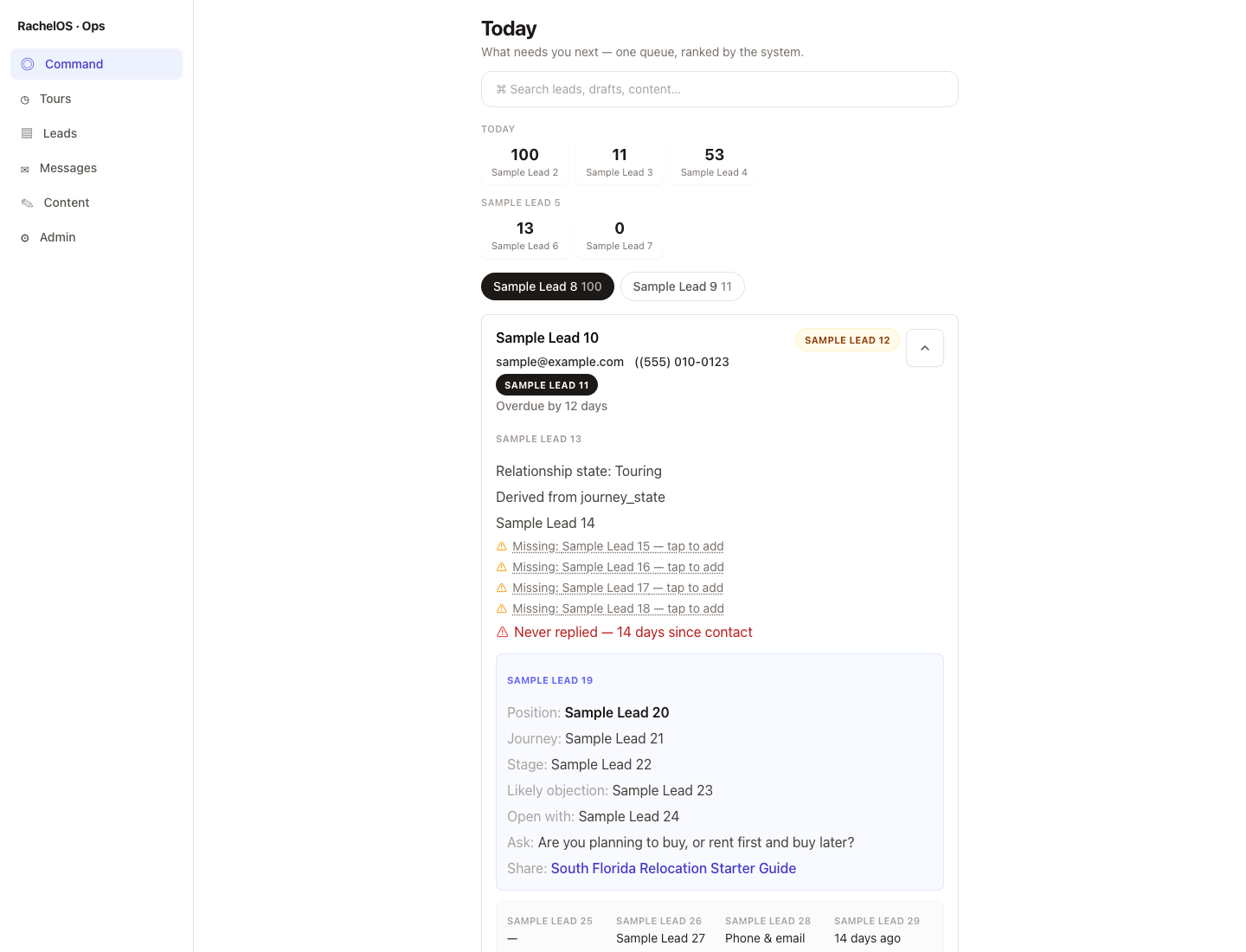
- One status, one owner, one next action. Every open lead has exactly one of each. If it doesn't, that is itself a flag.
- One ranked queue. Each morning the question "who needs attention today, and why?" is answered by the system instead of being rebuilt from four tools. In RachelOS, every item in the queue carries its reason: what triggered it, how long it has waited, and what is missing.
- Drafts, with a person deciding. The system drafts the next message and suggests what to send. A person approves anything that goes to a customer. Seventy-seven messages went out that way by July.
- Alerts for silence. Twice, leads stopped arriving for several days and nobody noticed. The system now raises an alert when nothing comes in, because the most expensive leak is the one you can't see.
Where AI helps, and where it doesn't
AI is genuinely useful here for the work people do badly under time pressure: drafting a first response, summarizing a lead's history before a call, noticing the one missing fact worth asking for, and flagging a conversation that has gone quiet.
It is not useful as an unsupervised salesperson. RachelOS once had automated AI follow-up switched on. It started stating things that weren't true, so I turned it off, and a person approves every customer-facing message to this day. The system also never lets an AI-extracted fact overwrite something a human entered. A wrong message to a good lead costs more than a late one.
Find your leaks in an afternoon
You can do a rough version of this yourself before paying anyone:
- Export every lead from the last 90 days.
- Mark each one: touched or untouched, replied or silent, and by which channel it was first contacted.
- Count the untouched ones. That number is your most direct leak.
- Work out the reply rate by first-touch channel. Look for the channel you rely on most and compare.
- For every open lead, check for one owner, one status, and one dated next action. Count the ones missing any of the three.
- Put a rough value on it: untouched leads × your typical close rate × average deal value. It will be an estimate. It will also be larger than you'd like.
What to fix first
Fix in this order, and resist skipping ahead to tools:
- Ownership. Every open lead gets one named owner today.
- Status. One field, a handful of values that mean something, and everything else retired.
- The daily queue. One list, ranked, with the reason on each item.
- Channel. Put effort where replies actually come from.
- Then automation. Drafts, reminders, and alerts, with a person approving what reaches customers.
Most businesses start at step five. That is why the leaks survive the new software.
If you'd rather have someone do the counting and build the fix, that is what the Constraint Diagnostic is for: two weeks to find where leads, work, and decisions stall in your business, what it's costing, and a fixed-price plan for the first fix. You can see how the system described here was built in the RachelOS case study.
The RachelOS figures come from one business, as of July 2026, with small samples where noted. They describe what was measured there, not what you should expect. No revenue or conversion improvement is claimed.