Operational Recovery Assessment
Your business should not depend on a few people to keep moving.
TKO finds the bottlenecks, decision gaps, and key-person dependencies that slow execution, consume capacity, and leave revenue or service at risk. Then leadership gets a clear, evidence-based next move.
Timeline
1 week
Fixed scope.
Investment
$5K-$8K
Set before the assessment starts.
Output
Executive briefing
Plus the six operating deliverables below.
Problem Statement
The failure is rarely effort. It is a business that depends on invisible work.
Critical knowledge lives in a few people. Decisions wait for meetings. Status looks green while risk builds. Teams work around the problem because the real constraint has never been made visible.
Key people → critical context → delayed judgment → stalled execution
The assessment exposes where the chain breaks and turns it into findings leadership can act on: ownership gaps, decision delays, capacity drag, revenue exposure, and the smallest change likely to improve performance.
Who It Is For
For leaders with a real performance problem, not a general interest in AI.
The best fit is a team with a workflow or revenue process under pressure, a visible trigger, and a decision about what deserves investment.
COO, VP Operations, VP Revenue, or Customer Success leader with an active workflow stall.
PE operating partner or owner-operator trying to see where execution risk is building.
Relationship-driven business where critical judgment, follow-up, and escalation live in a few heads.
Healthcare operations leader working from warm or referral context, framed as advisory experience.
What The Assessment Is
Six deliverables that turn a vague problem into an executive decision.
The work is constrained on purpose. It gives leadership enough evidence to see the constraint, the exposure, and what should happen next.
01
Workflow map
02
Bottleneck analysis
03
Dependency analysis
04
AI readiness assessment
05
Operational risk assessment
06
Executive briefing
Timeline
A one-week assessment, not open-ended consulting drift.
The price expectation is $5K-$8K. Scope, access, and timing are confirmed after the 30-minute discovery call.
- Day 1
Scope
Confirm the workflow under pressure, the operating questions leadership needs answered, and the evidence available this week.
- Days 2-3
Interviews and evidence
Review the current process, handoffs, reports, exceptions, key-person dependencies, and places where status hides risk.
- Day 4
Analysis
Synthesize workflow visibility, bottlenecks, dependency risk, AI readiness, and operational exposure into a clear assessment.
- Day 5
Readout
Deliver the executive briefing and the single highest-leverage next move. No obligation to continue.
RachelOS Proof
Backed by a live system that supports real revenue work.
RachelOS is not a slideware example. It is a production system for a South Florida real-estate business that turns fragmented context into prioritized work, automated nurture, and human-approved action.
Deployed proof
Runs daily. Supports three closed transactions to date. Includes active conversation management, automated email nurture, and human-approved AI assistance.
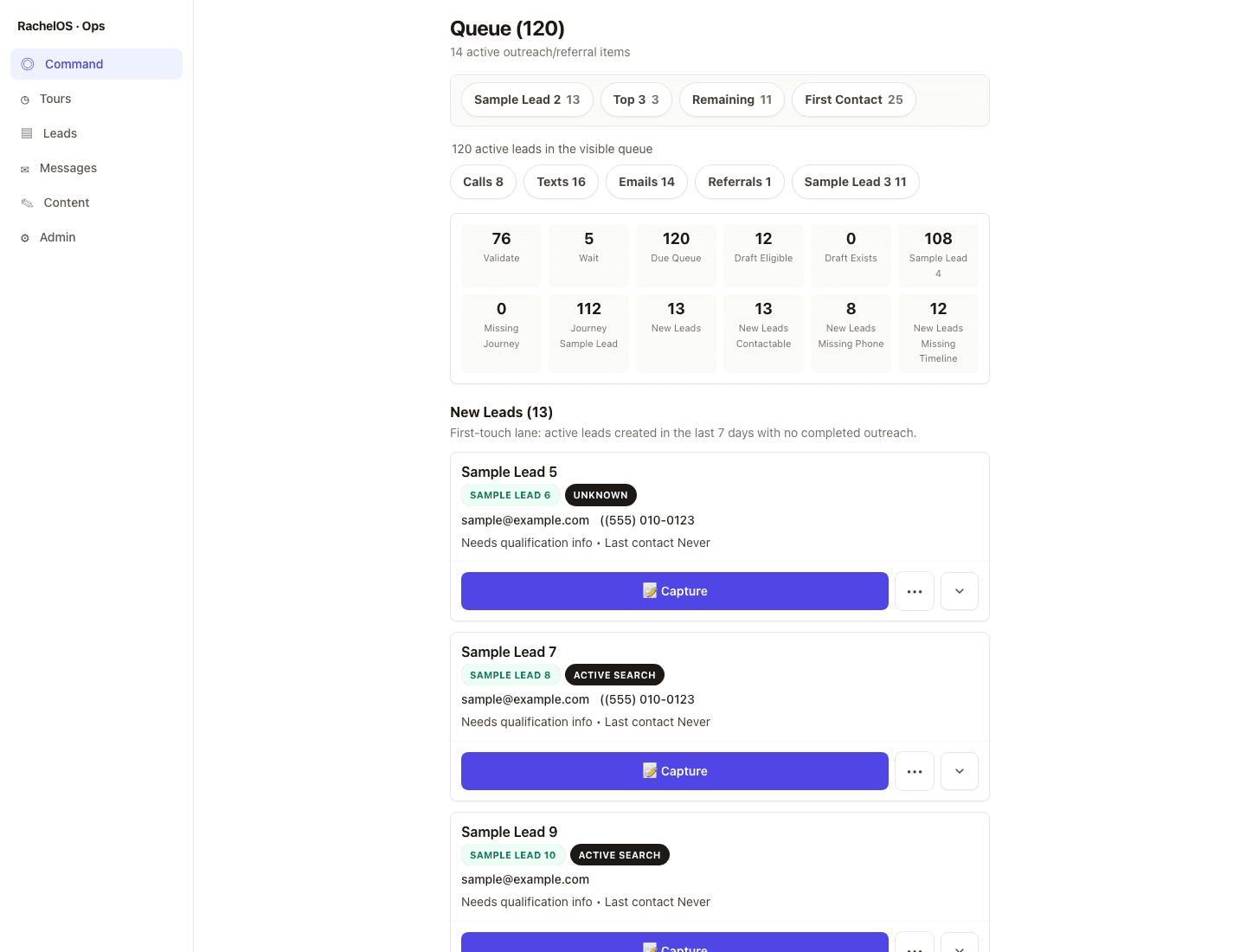
Canonical Queue
A live queue ranks active leads, work lanes, attention counts, and what should happen next.
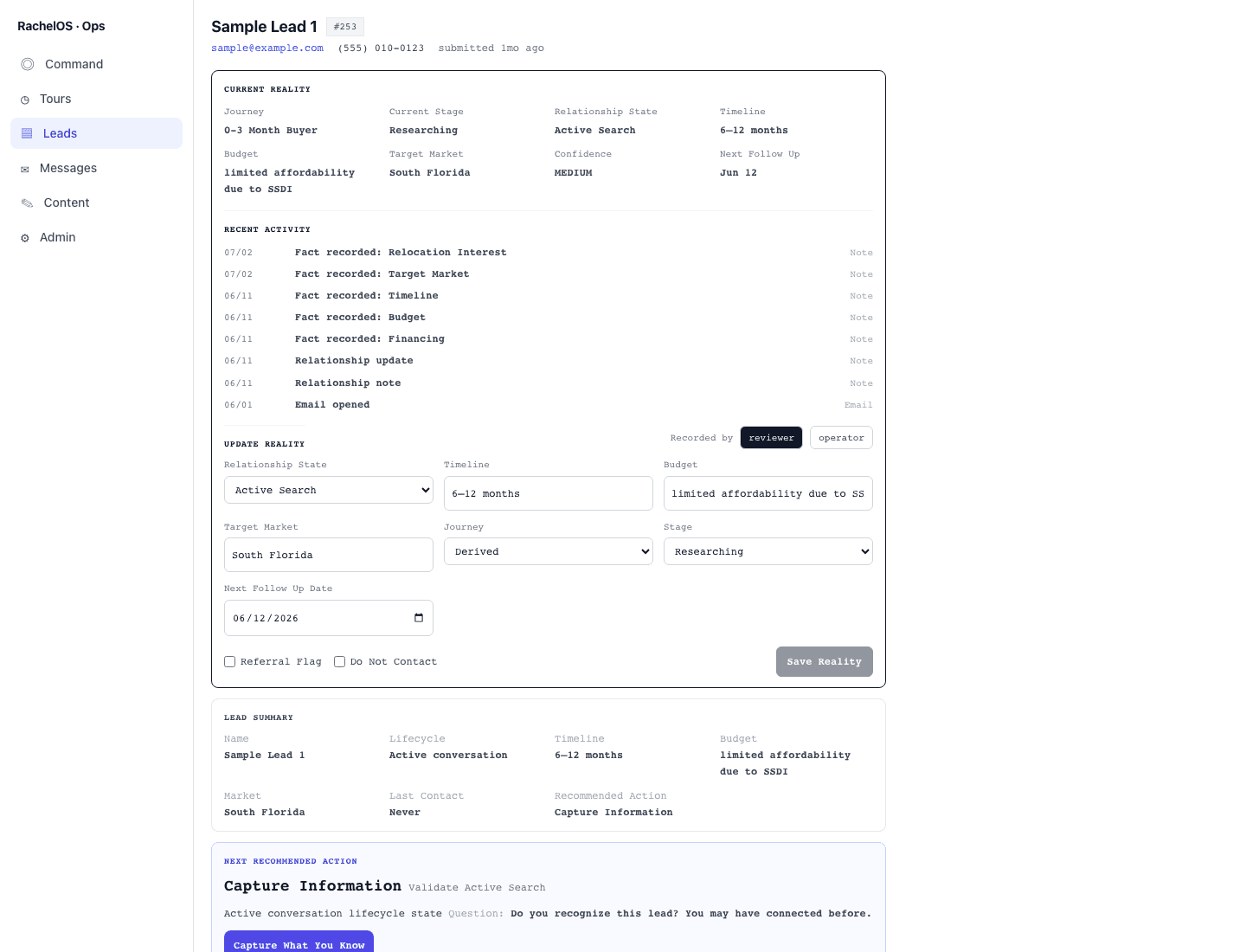
Relationship Memory
A lead workspace preserves current reality, recent activity, known facts, and the recommended next action.
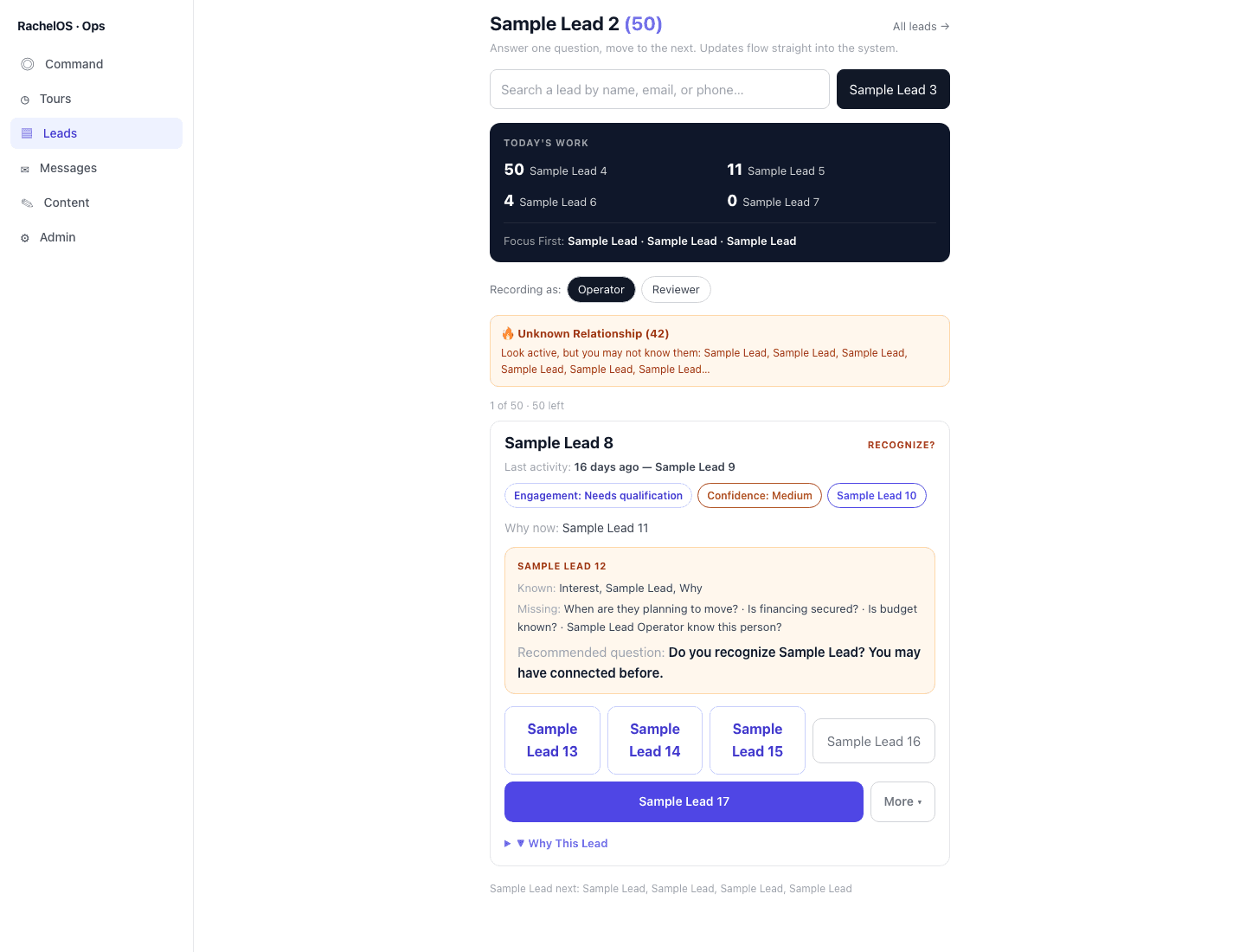
Human Approval
Recommended questions and relationship updates stop at the human approval surface before work moves forward.
Outcomes
What leadership walks away with.
The assessment does not invent a business case. It clarifies the problem, the business exposure, and the next decision.
- A clear, evidence-based view of the top three places work stalls.
- Identification of the key-person dependency and the risk it creates.
- An honest read on where AI can safely help with human approval, and where it cannot yet.
- The single highest-leverage next move for leadership to decide on.
Next Step
Discuss the business problem. Then decide whether the assessment is a fit.
The first step is a focused executive conversation. If the problem is concrete and there is mutual fit, TKO confirms scope, price, timing, and the evidence needed to produce a useful decision.
01
Assessment
One fixed week to establish the operating truth and the next highest-leverage move.
02
Diagnostic
A deeper investigation when the problem needs stronger evidence, prioritization, and implementation design.
03
Build
A governed Operational Knowledge System when the right system shape is already clear.
04
Advisory
Ongoing operator-to-operator support when leadership needs help keeping the work governed.
FAQ
Questions buyers should resolve before intake.
How long does the assessment take?+
The assessment is one week, fixed scope. The week covers scope, interviews and evidence review, analysis, synthesis, and an executive readout.
What access do you need?+
TKO needs access to the workflow evidence already available: process notes, reports, handoff points, examples of stalled work, and interviews with the people closest to the workflow. No new platform or integration is required.
How is confidentiality handled?+
The assessment is treated as confidential operating work. TKO does not publish client names, metrics, screenshots, or internal findings without explicit approval.
What happens after the assessment?+
You receive the executive briefing and the recommended next move. If there is a fit, the path can continue into a Diagnostic, Build, or Advisory engagement. There is no obligation to continue.
Is this an AI or software implementation?+
No. The assessment diagnoses the operating problem before implementation. It identifies where AI or automation may help with human approval, and where the workflow is not ready for it yet.
Related Reading
Operating patterns behind the assessment.
These articles explain the two common signals the assessment is designed to surface: reporting that does not produce action, and critical knowledge trapped in individual people.
Operational Intelligence vs. Reporting
Why dashboards often describe work after the decision should already have been made.
Read insightHuman APIs Become Organizational Bottlenecks
How critical judgment trapped in one person becomes the hidden operating constraint.
Read insightExecutive operating review
Find what deserves deeper investment.
A focused assessment identifies the constraint, the key-person or decision risk behind it, and the highest-leverage move before a larger transformation or technology commitment.