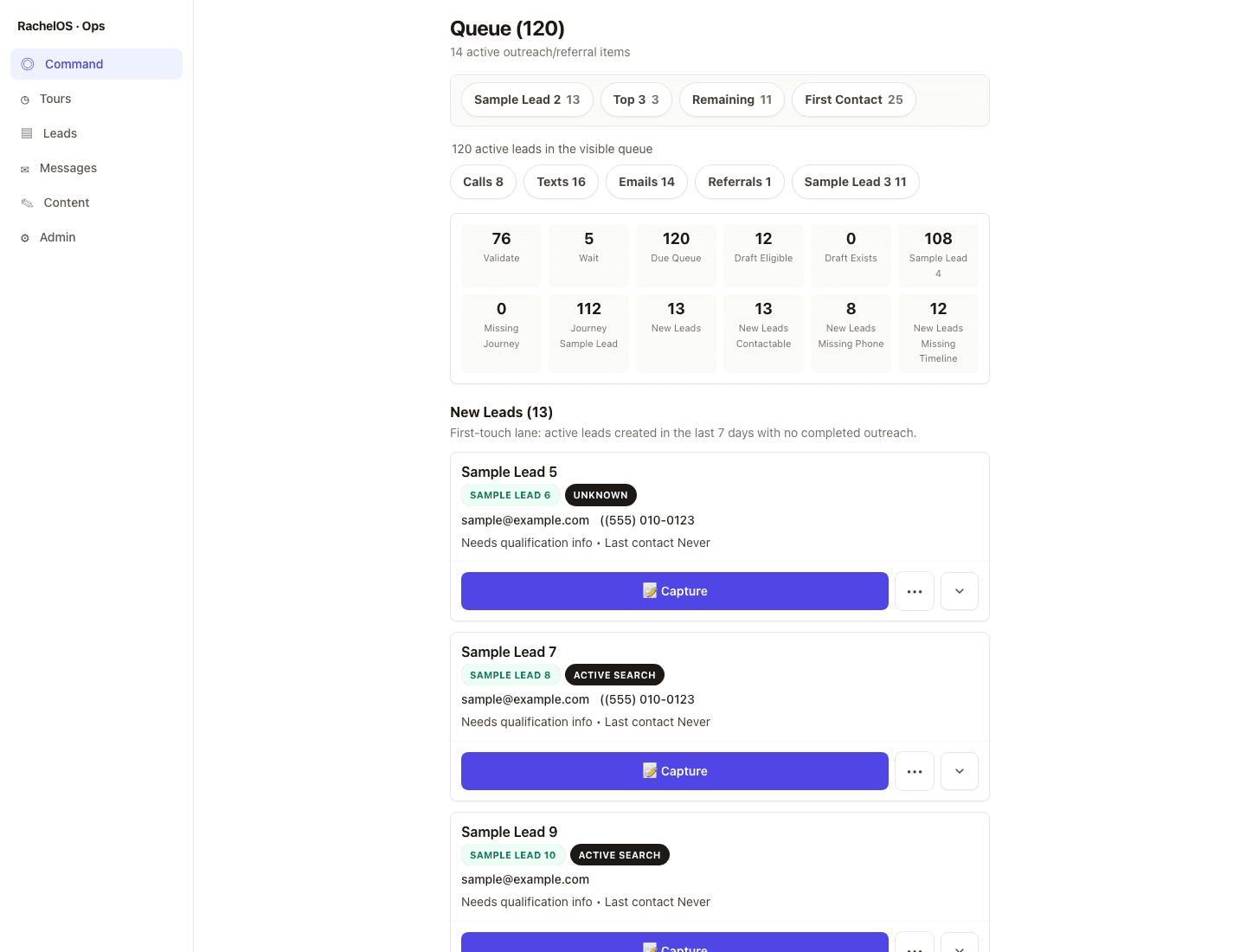
Canonical Queue
A ranked view of active work and the next action that should happen.
Built System / Direct Proof
RachelOS is in daily use in a relationship-driven business. It replaced manual reconstruction across records, messages, notes, and activity with durable context, a trusted priority queue, and human-governed action.
The business had information across a CRM, email, text threads, notes, calendar, and spreadsheets. The hard question—who needs attention now, why, and what should happen next—still required the operator to reconstruct the answer each day.
Critical relationship context, prioritization, and exception handling lived in one person. The business had systems of record, but not a system of action. Attention, rather than information storage, was the constraint.
The work identified three linked failures: information fragmented across sources, operational knowledge concentrated in a person, and no mechanism that continuously converted what was known into a ranked, trustworthy next action.
System Design
The implemented pattern is signals to memory to facts to state to priority to human approval to action. It is a workflow and decision design, not an autonomous-agent claim or a real-estate software offer.
Relationship updates preserve context from conversations and activity so the operating picture no longer depends on one person reconstructing it from multiple places.
Unstructured updates resolve into source-aware facts. Human and lead facts outrank AI interpretation; current state informs the recommendation but is not treated as truth itself.
A canonical queue determines one next action from facts, state, freshness, and governance. A daily action engine turns priority into an operator work surface.
AI can extract, draft, and recommend, but humans approve consequential action. System health, cron logging, smoke tests, and alerts make silent operational failure visible.
RachelOS has implemented lead capture reliability, relationship updates, source-aware fact extraction, journey and relationship state, intelligence-gap detection, a canonical next-action queue, a daily action engine, approval-gated outreach drafting, content workflow controls, referral handling, and operational health checks. The evidence is code-, schema-, route-, and documentation-backed.
What It Proves
RachelOS demonstrates that fragmented signals can become durable operational memory, source-aware facts, a prioritized action queue, and human-governed execution in a live operating environment.
What It Does Not Yet Prove
RachelOS does not provide a published revenue, conversion, ROI, or adoption result. Outcome attribution, reporting, and referral close-loop measurement remain incomplete. It is not a healthcare product or proof of healthcare compliance.
Evidence
These redacted proof assets demonstrate implementation surfaces. They do not claim commercial performance metrics.
A ranked view of active work and the next action that should happen.
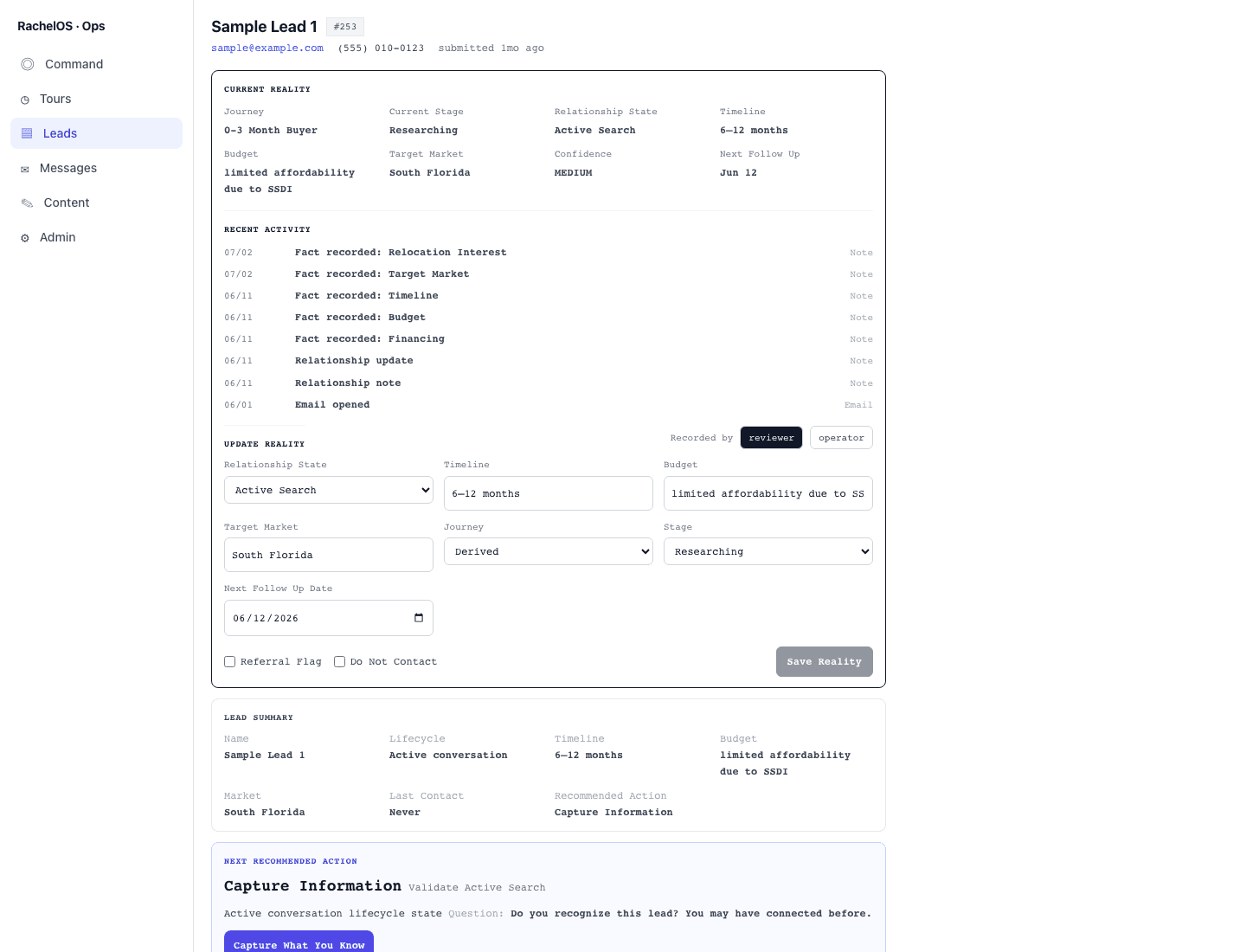
A durable relationship view for current reality, known facts, recent activity, and next action.
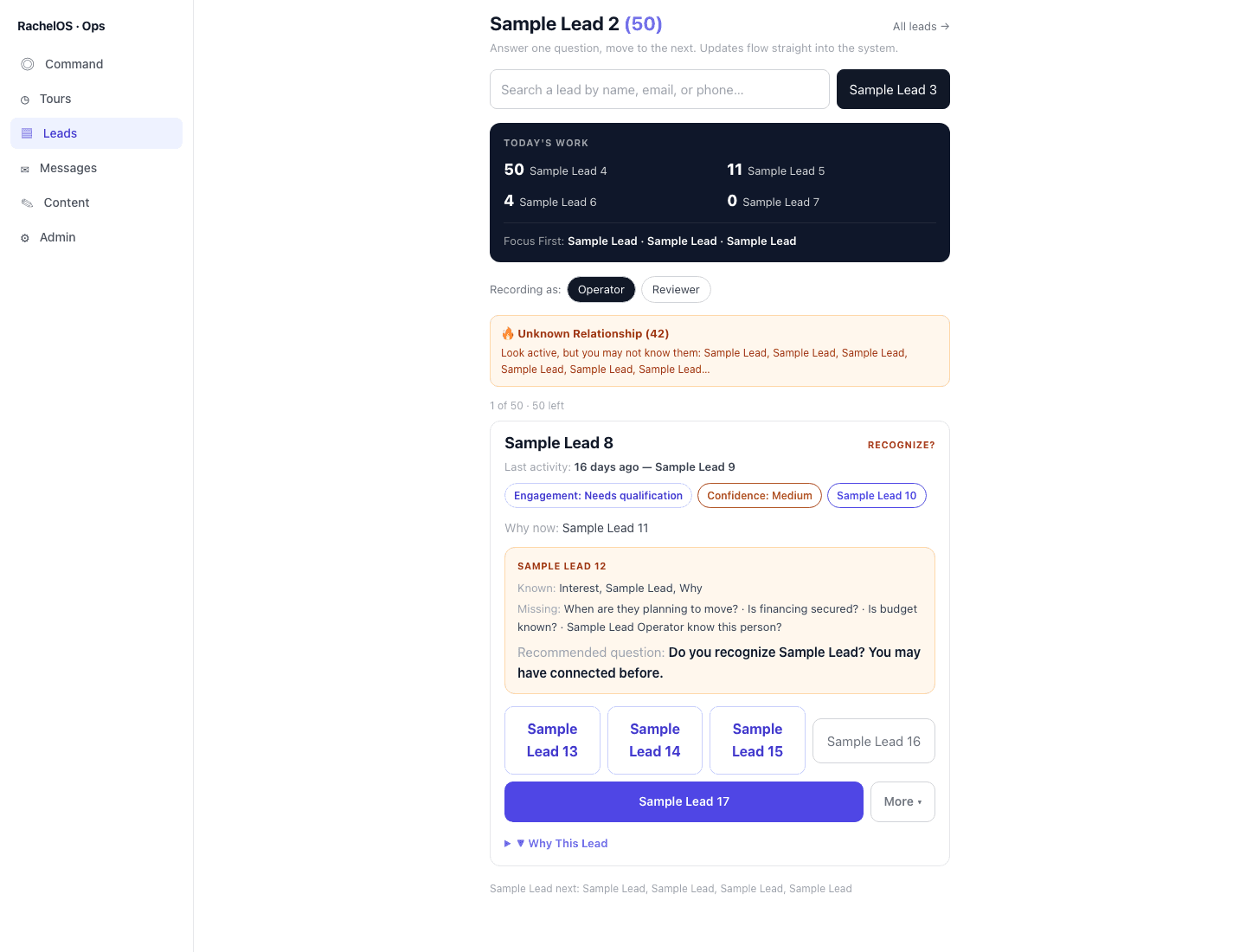
An operator review surface before AI-assisted relationship updates and recommendations move the work forward.
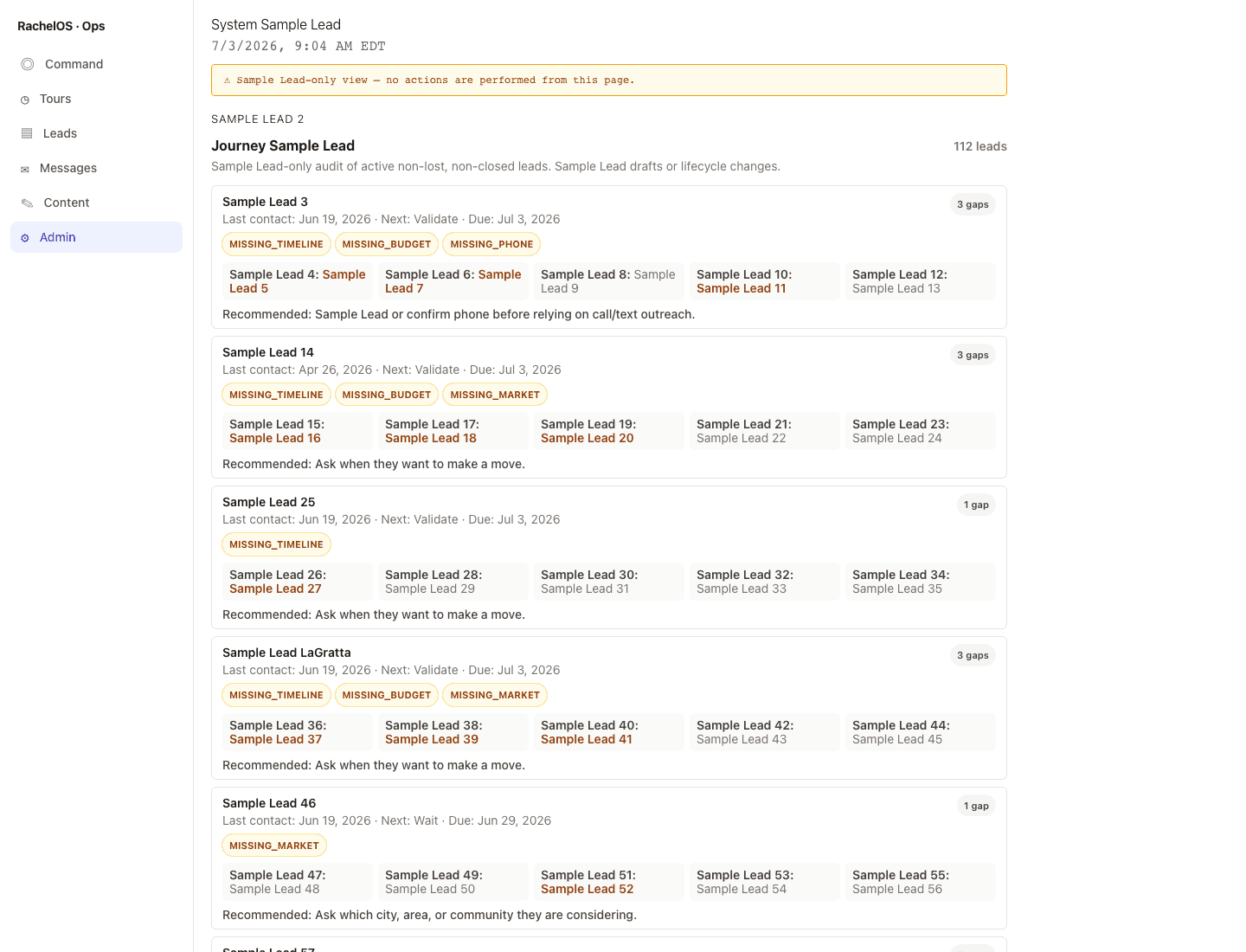
Operational checks and execution status make the system's own reliability visible.
Operational Recovery Assessment
The Assessment starts with a concrete stalled workflow, identifies the hidden constraint, and determines the next highest-leverage move before a larger build is considered.